
Data as the New Astrology
Jeremiah's Critique of Fatalism

In the winter of 671 BCE, in the reign of Esarhaddon, king of Assyria, the moon slid into the earth’s shadow and hung over the rooftops of Nineveh the color of dried blood, and the court astrologers sent word to the palace that the king was going to die. For generations the scholars of Assyria had kept the great omen series, tablet after tablet correlating events in the sky with events on the earth, and the rule for a lunar eclipse in the wrong month, darkening from the wrong quarter of the disk, was fixed: it meant the death of the king. Their reading admitted no appeal. The sky had spoken in the one grammar it had.
So Esarhaddon, ruler of the largest empire the world had yet seen, did the rational thing. He got off the throne. In his place the scholars installed a substitute, the šar pūhi, the “substitute king,” usually some simpleton or condemned man, dressed him in royal robes, gave him a woman to be his queen, and seated him on the throne to reign. The real king withdrew and was addressed, during this interval, as “the farmer.” The substitute held the office, and with it he held the omen; the predicted death was now aimed at the man wearing the crown. When the dangerous period passed, up to a hundred days later, they put the substitute to death. The heavens had called for a dead king. They were given one. Esarhaddon came back from the fields and resumed his reign, the sentence served by another body.
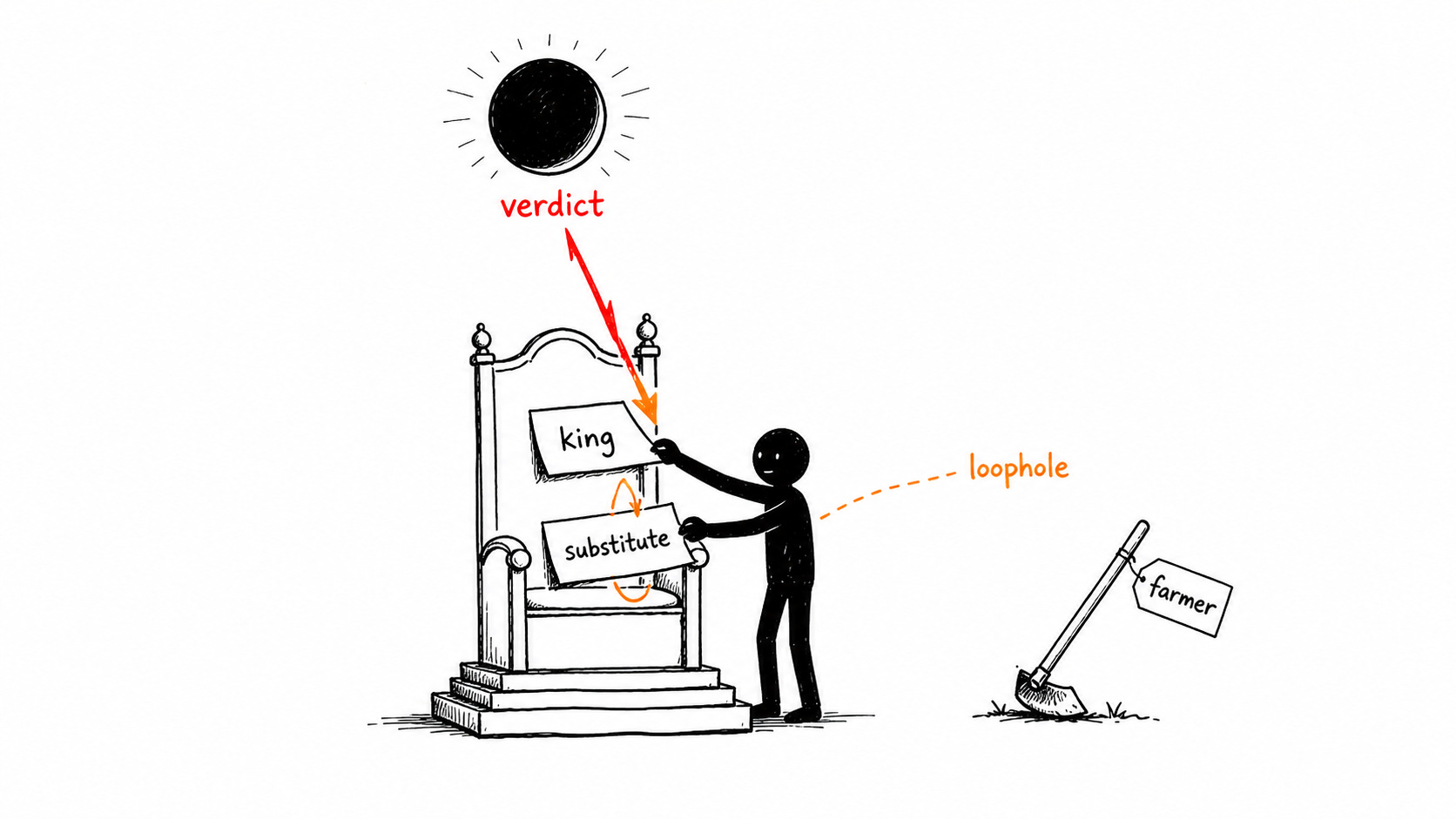
Nobody prayed for the omen to relent. The sign is a verdict already entered, and the only intelligence the situation permits is the engineering of a loophole, a way to route the machinery’s output onto a disposable body. The gods are bound by the bluntness of their rules.
The king has one move: game the data.
In 2026 the substitute king is an app.
The Assyrian sky has been rebuilt, and now it rides in a pocket. Tens of millions of people open Co-Star, the astrology app that draws its charts from the same NASA ephemeris data that steers spacecraft, to be told what the configuration permits and forbids them that day; the app built its following on push notifications, small daily verdicts dropped onto a lock screen, “you are not the main character,” “take a break from being yourself.” “It’s a good day to meet someone new.”
Beneath the zodiac runs the serious version of the same thing: the credit score that decides the loan, the actuarial model that prices the life, the recidivism algorithm that advises the judge, the recommendation engine that has decided, from the pattern of your clicks, what kind of person you are and will be.
Between the horoscope and the credit score sits every other instrument for fixing a person in advance: the Myers-Briggs letters on the conference lanyard, the Big Five profile the psychologist trusts, the polygenic score read off a tube of saliva, the base rate that rides on a zip code or a surname.
Each takes the configuration you were issued at birth and hands back a type, and a statistical forecast, an implied trading range.
Today, the Assyrian omen series is rewritten in the language of big data. The old astrology is dismissed by the likes of Steven Pinker as unfalsifiable bunk, but the new astrology is hailed as rigorous. The problem was never the fatalism; only the model.
Reductionist approaches take the same posture the Assyrian king took toward the eclipse. Your fate is sealed.
You do not argue with your score.
You optimize it, the way Esarhaddon optimized the omen, by managing the inputs and hoping the verdict lands somewhere survivable.
The sky has been replaced by the dataset, the baru-priest who read the omen tablets by the social scientist that reads you, and the dread is exactly the dread of a man who has been told the stars require his death and knows of no one to ask for a different ending.
It is into this exact fear that a verse in Jeremiah speaks, and it has been so thoroughly domesticated as “the Bible is against astrology” that its strangeness is gone. Jeremiah the prophet, active in Jerusalem in the decades before the Babylonian exile, watching his people about to be marched into the heartland of celestial divination, says this:
כֹּה אָמַר ה׳ אֶל־דֶּרֶךְ הַגּוֹיִם אַל־תִּלְמָדוּ וּמֵאֹתוֹת הַשָּׁמַיִם אַל־תֵּחָתּוּ כִּי־יֵחַתּוּ הַגּוֹיִם מֵהֵמָּה
“Thus said the LORD: Do not learn the way of the nations, and do not be dismayed by the signs of the heavens, though the nations are dismayed by them.” (Jeremiah 10:2)
Read it slowly and a hinge appears that the flat anti-astrology reading walks right past. The verse leaves the signs of the heavens their reality; what it forbids is being dismayed by them. And here, I’d add, not just being afraid, being a doomer, but being obsessed in general with chart reading.
And Jeremiah binds that dismay to a prior act. Do not learn the way of the nations, and then you will not be terrified by the signs. The fear is presented as a downstream consequence of an education. Something about adopting the nations’ way of reading turns the sky into a source of terror. The same lights overhead become, depending on the schooling you bring to them, either bearable or unbearable. Jeremiah is making a claim about what learning does to the learner.
The Torah’s first words about those lights describe an entirely different relationship to them. On the fourth day:
וְהָיוּ לְאֹתֹת וּלְמוֹעֲדִים וּלְיָמִים וְשָׁנִים
“and they shall be for signs and for appointed times, and for days and years.” (Genesis 1:14)
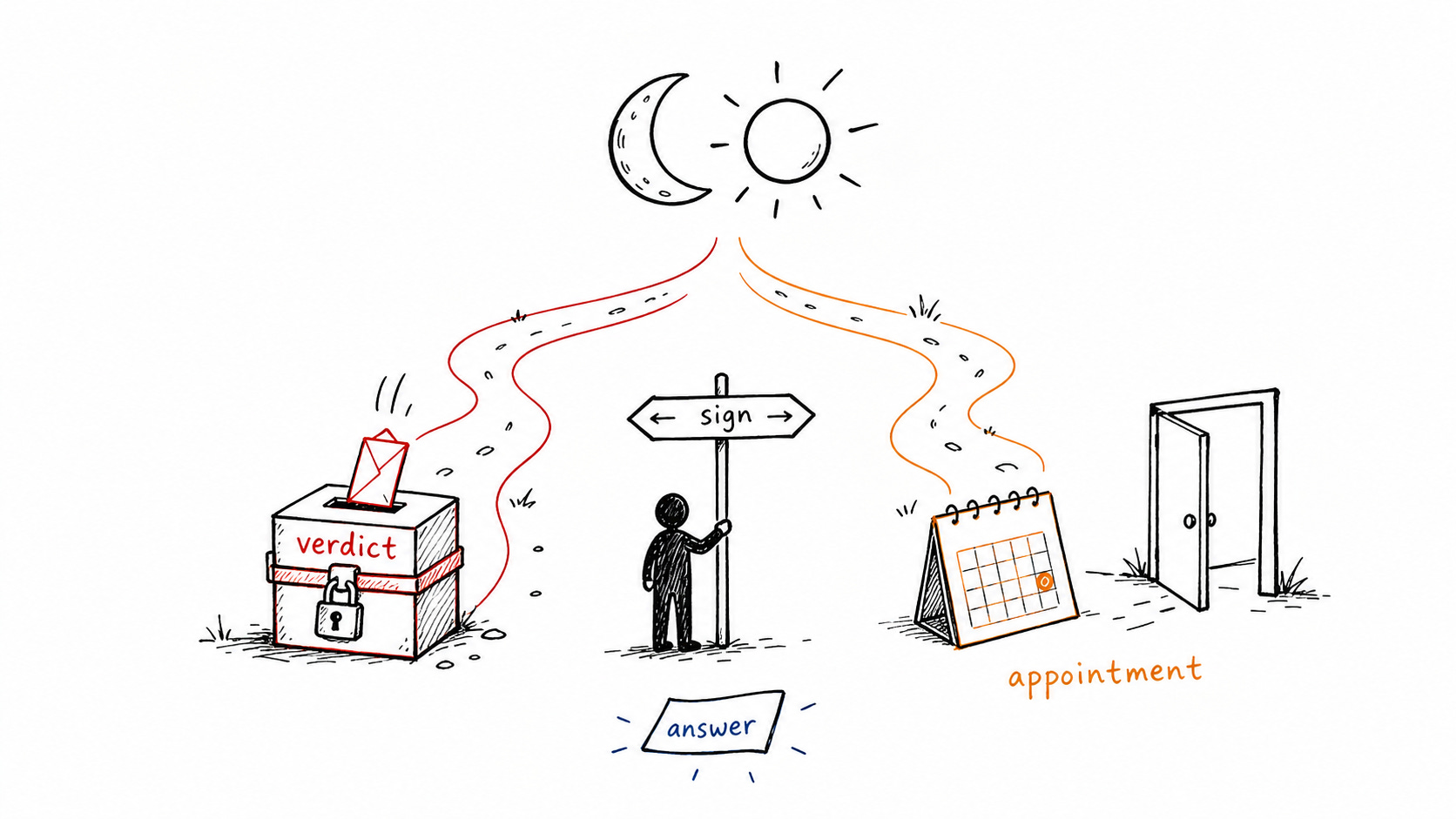
The luminaries are otot, signs, and mo’adim, appointed times, the word that will later name the festivals. Look at the sky and let it help you create a sense of sacred time.
This is the vocabulary of a calendar, not a verdict.
A sign in this sense points past itself to the thing it marks; it sets the time for an action you will take. The new moon opens the month. The sun fixes the hour of prayer.
How that same sky becomes a tyranny is laid out a few chapters into Deuteronomy. Moses warns the people against looking up and being “lured into bowing down” to the sun and moon and stars, “which the LORD your God allotted to other peoples everywhere under heaven” (Deuteronomy 4:19). The heavenly host is allotted, chalak, portioned out to the nations as their mode of governance.
As I’m arguing, the proscription isn’t simply against nature worship, but against the fatalism implied by the cultures that engaged in it.
There is a way of standing under the sky in which the sky is your god and your administrator, in which the configuration overhead is the final word on your life. That arrangement is real, the verse concedes, and it is assigned to the nations. Israel is described in the very next verse by contrast: taken by God directly out of Egypt, out of “the iron furnace,” into relationship. Two ways of being are placed side by side. One lives under the cosmic system. The other lives in a covenant. One is administered. The other is addressed. One is governed by a self-fulfilling fate, the other by a sense of freedom.
And because the second way could leave a vacuum where the nations have their elaborate technologies of foreknowledge, Deuteronomy does more than prohibit; it substitutes.
The long ban comes a few chapters later, against the augur and the soothsayer and the one who reads omens and the one who inquires of the dead, the whole apparatus by which the nations extract the future in advance. In the middle of it stands a single demand: תָּמִים תִּהְיֶה עִם ה׳ אֱלֹהֶיךָ, “you shall be wholehearted with the LORD your God” (Deuteronomy 18:13). And then, immediately, in place of all the banned arts, the text installs its own institution: a prophet. The nations have diviners; you will have a navi. The contrast is deliberate. The diviner reads a future that is already fixed and reports it back, and you can do nothing with the report except brace. The diviner just reads the chart. The prophet brings a word from someone, a word that names what you have done and what will follow and what you might still do about it; fundamentally the prophet exists to help the people change, and even, to get God to change; the prophet finds the quantum wedge in which sleight behavioral shifts can be civilizationally decisive.
The diviner’s future is a forecast. The prophet’s future is a summons. One closes the matter. The other opens it.
This is the seam Jeremiah is working, and his verse turns out to be a braid of all three threads. “Do not learn the way of the nations” is the prohibition of Deuteronomy 18. “The signs of the heavens” are the otot of Genesis 1, the host allotted to the nations in Deuteronomy 4. And “do not be dismayed” names the precise emotional event that occurs when you read signs as fate: the heart drops, techat, the same root as terror, because a verdict has come in and there is no one to appeal to. The nations are dismayed by the signs, Jeremiah says, because that is what their schooling produces. They have learned to read the sky as a sentence, and a sentence terrifies.
Malbim draws the causation out into a single sentence. If you do not learn the way of the nations, he writes, then you will not be terrified by the signs of the heavens, “for you are placed under the providence of God, not under the array.” It is a form of “ignorance is bliss,” but in a more dynamic way. By not ascribing power to the heavenly bodies, they lose their power.
“Only when you learn the way of the nations do you exit the conduct of providence.” The line between the two ways of living turns out to be permeable, and you cross it by what you learn. Acquire the nations’ reading and you have, by that act, stepped out from under being addressed and into being administered. You have enrolled yourself in the array.
The Talmud takes the question up directly, and it does not open in agreement. There is a sugya in tractate Shabbat 156a debating whether mazal, constellation, fortune, the configuration of the stars at your birth, governs a Jew. Rabbi Chanina, the Galilean master of the older generation, says plainly יֵשׁ מַזָּל לְיִשְׂרָאֵל, there is mazal for Israel; a constellation makes one wise, a constellation makes one rich, and its reach does not stop at the chosen. Against him Rabbi Yochanan of Tiberias states the position that became the slogan: אֵין מַזָּל לְיִשְׂרָאֵל, Israel has no mazal. No constellation governs the fate of the Jews.
Both sides grant that the stars pull; one of them says so outright. What they fight over is whether a Jew is the kind of being that pull gets to govern. Asked from where he derives his side, Rabbi Yochanan quotes the verse from Jeremiah we’ve been discussing. The proof-text for the claim that the configuration does not govern you is the very verse forbidding you to be dismayed by it. The tradition heard in Jeremiah’s warning a statement about ontology rather than a ban on a folk practice: you are not the kind of being a mazal can govern.
To show what that means the Gemara reaches back to Abraham. Rav reads the scene where God takes Abraham outside to look at the stars and promise him children. Abraham, Rav imagines, answers like an astrologer, because that is what a Chaldean of Ur would have been. “Master of the Universe, I have looked into my astrology, and I am not fit to have a son.” He has read his own chart and found no future in it. And God says back to him: צֵא מֵאִיצְטַגְנִינוּת שֶׁלְּךָ, “Emerge from your astrology, for Israel has no mazal.” Step outside the system you are standing in.
A parallel midrash in Bereshit Rabbah gives God’s answer its sharpest form: נָבִיא אַתְּ וְאֵין אַתְּ אַסְטְרוֹלוֹגוֹס, “You are a prophet. You are not an astrologer” (Bereshit Rabbah 44:12), drawing the explicit contrast we saw implied in Deuteronomy.
The astrologer receives the configuration as a closed report. The prophet stands inside a relationship in which the future is still being spoken. Abraham’s whole election is a single instruction: stop reading the heavens as a sentence and start hearing them as a summons.
The same sugya then tells what living outside the array looks like in practice. Shmuel, the Babylonian sage and astronomer, sits with a gentile scholar named Ablet, and they watch a group of men head to the marsh. Ablet reads the signs: that one will go and not return, a snake will kill him. Shmuel says, if he is a Jew he will return. The man comes back. They open his bundle and find a snake inside it, cut in two. What did you do today, Shmuel asks him. Nothing, the man says, except that at the shared meal one of us had no bread and was ashamed, and I covered for him so no one would know. The omen was accurate. The snake was real and waiting. What the act of quiet tzedakah, of covering another man’s shame, accomplished did not touch the reading at all. It lifted the man out of the jurisdiction in which readings are binding. In a sense, both sages are right. Ablet is statistically right; but as Nassim Taleb is fond of saying, we don’t get paid in expected value. Ironically, we’d describe the man as “lucky,” and yet in the context of the story what we really mean is that he is an outlier.
Rabbi Akiva’s daughter, the same sugya continues, was told by Chaldeans she would die by snakebite on her wedding night, and she lived, because on that night she had given her own portion to a beggar no one else had heard at the door. The stars had it right. She was simply no longer the kind of being the stars decide, because she had acted as one who is addressed and can answer, and an addressee is not a verdict.
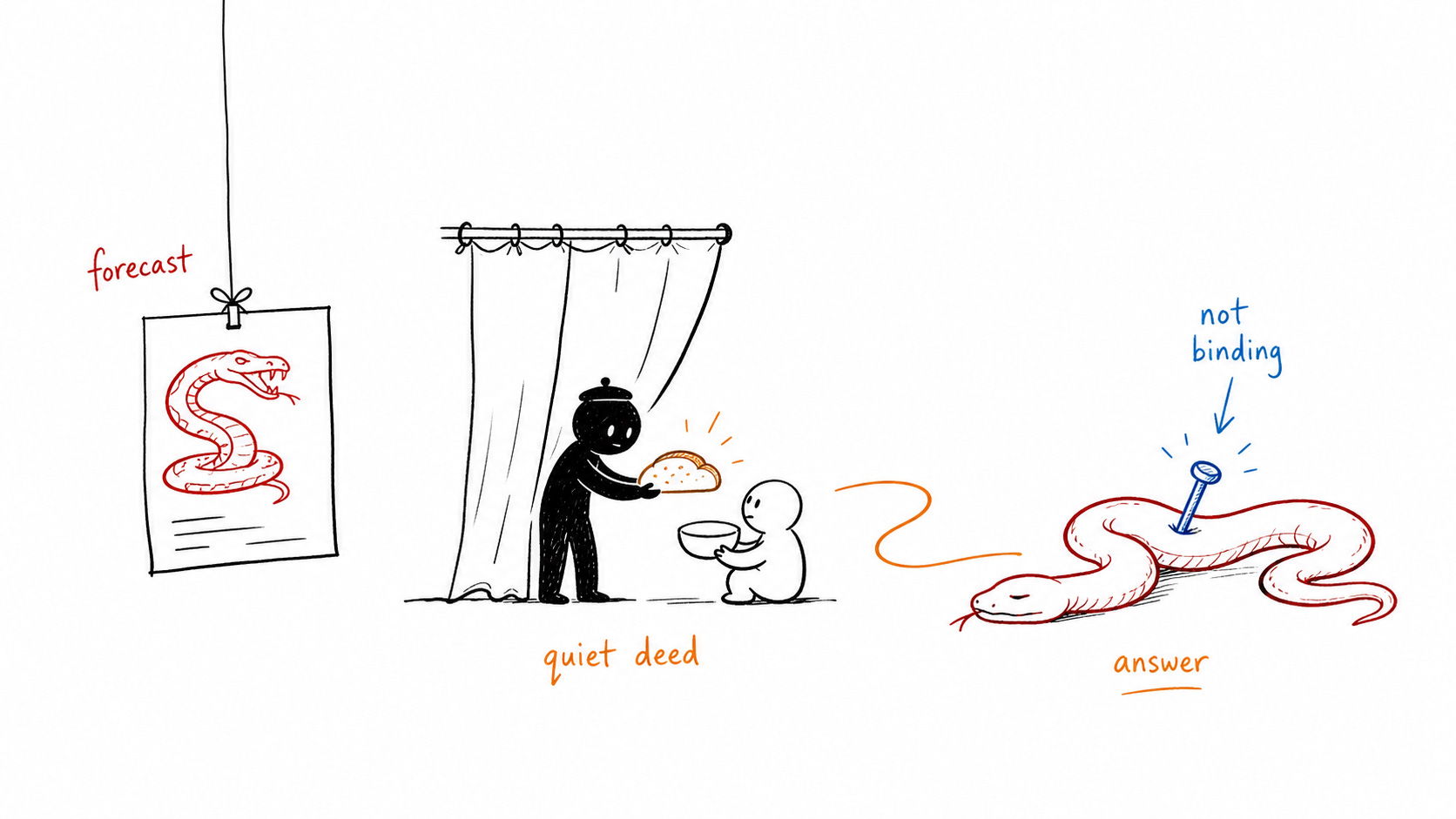
Where the Assyrian king needs a double to take the fall, these Talmudic heroes are their own doubles, shedding the path not taken to become survivors of their own dead ends.
The stars keep their force and lose their sovereignty. There is a constellation that makes one rich and a constellation that makes one wise, and there is also the portion Rabbi Akiva’s daughter carried to the beggar while the wedding waited, and the second is not governed by the first. No analysis is pure. The fatalism of the Chaldeans is wrong at the individual level, but might still be a good trading strategy for a macro investor.
Which is why the quarrel with mazal is, underneath, a quarrel about merit.
The chart, the type, the base rate of the kind you were born into, is precisely the part of a life that no one earned. To read it as destiny is to say a person is the sum of what he was handed, that the well-starred will rise and the ill-starred will fall and the whole of it can be read off the natal data in advance. Judaism concedes the inheritance and refuses the sentence. Yesh mazal, the luck is real, the constraints are real, you did not deal your own hand; and the deed you do tonight is yours in a way the hand never was, and the deed is what decides. Know the statistics. Do not be dismayed by them.
Rashi, reading the “signs” of the fourth day, says plainly that an eclipse is indeed an ill omen for the world, then quotes Jeremiah’s verse and finishes the thought: “when you do the will of the Holy One you need not dread the calamity.” The eclipse means something. The sign is real. What Rashi denies is that meaning is the same as verdict. The Assyrian read the eclipse and could do nothing but install a substitute to die in his place.
The most modern form of the array is the hardest to see, because it wears no zodiac. It is time itself.
The claim, in its strongest version, runs that a person can think only what his age permits him to think. Thomas Kuhn, the historian of science, called the reigning frame a paradigm and showed that researchers working inside one cannot quite see what researchers inside the next will find obvious. Michel Foucault called it the episteme, the buried grid that decides, in a given time period, what will count as knowledge and what will register as nonsense. Martin Heidegger called existence thrown, geworfen, cast without consent into a world and a moment already thick with a particular sense of what is, so that the self always arrives too late to choose the terms on which it understands anything at all. This is mazal widened to the size of an epoch. A kind of cultural fatalism.
The configuration overhead is no longer the stars standing at your birth but the entire conceptual sky of your century, and the sentence it hands down is that you are its product. Historicism is astrology for people who would never touch a horoscope.
Jacob meets this array in a dream. He lies down at Beth El with a stone under his head and sees a ladder set on the ground with its top in the sky, מַלְאֲכֵי אֱלֹהִים עֹלִים וְיֹרְדִים בּוֹ, the angels of God going up and down upon it (Genesis 28:12). The midrash in Vayikra Rabbah reads those angels as the guardian princes of the empires and turns the dream into a reel of history running forward: the prince of Babylon climbing seventy rungs and falling, Medea fifty-two and falling, Greece a hundred and eighty and falling, and then the prince of Edom, whom the tradition reads as Rome, climbing and climbing with no descent in sight. Jacob watches and is afraid, and asks whether this one alone never comes down. The answer arrives in a verse from Jeremiah: אַל תִּירָא עַבְדִּי יַעֲקֹב, do not fear, My servant Jacob (Jeremiah 30:10). Even should Edom climb up and nest among the stars, God tells him, from there I bring it down. What the dream confers on Jacob is a position. He stands on the ground and watches the empires rise and fall, and he is not himself a rung.
To say Israel has no mazal is to say this much too: that a people can refuse to be only a moment inside the history of its moment, can decline to take the measure of its worth from the step the age has assigned it, can stand slightly off the escalator and look.
The lesson is coming around again, more thoroughly than the Assyrians—the super-power of their time, but utterly gone now—could have managed. The omens are better now. You can even bet on them. And if you’re a high frequency trader with an edge, you’ll get rich. Your bets, aggregated with the bets of others, will in turn provide market signal. Your upside is the market rewarding you for providing price signal.
And yet history is not made by those who find a way to capture basis points on prediction models. It is made by those, like Rabbi Akiva’s daughter, who don’t fear; those who are nonplussed by the charts.